
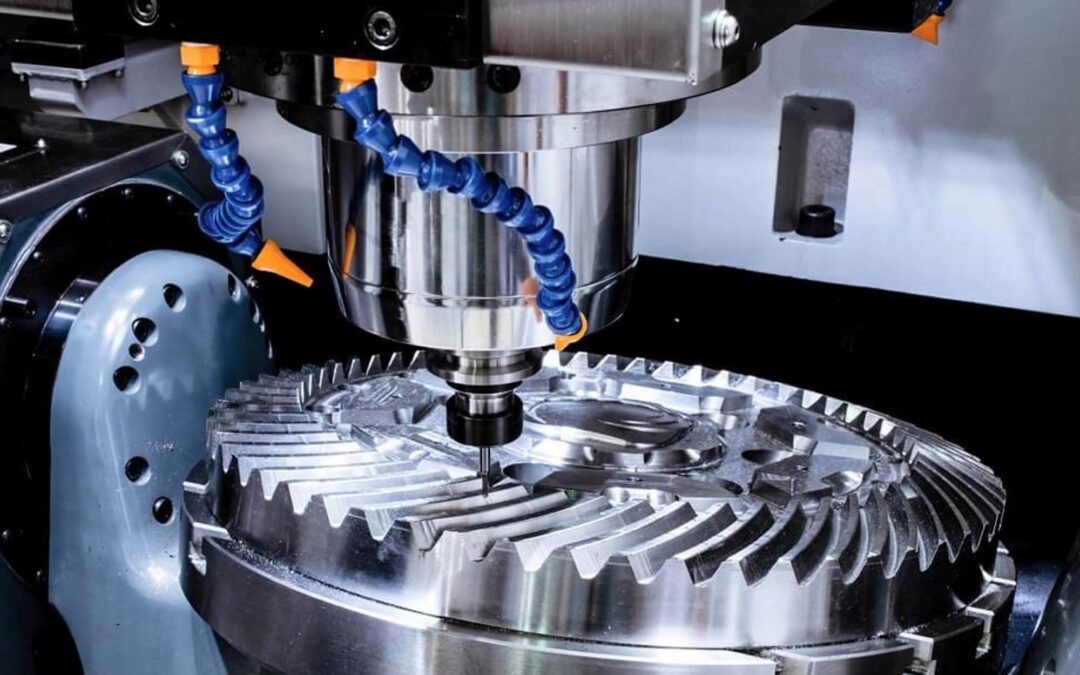
As turbine architectures advance toward higher thermal efficiency and greater power density, the machining of complex inner rim cavities has evolved into a mission-critical challenge for aerospace manufacturers, energy-sector suppliers, and precision engineering firms. These cavities frequently incorporate multi-curvature geometry, thin-wall sections, reinforcement ribs, asymmetric cooling passages, and compound radii that shift dynamically along the component’s circular footprint. Conventional machining approaches often introduce issues such as inconsistent material removal, unpredictable tool pressure, chatter marks, and thermal deformation, especially when the cavity profiles tighten or geometry transitions steepen. In response, CNC variable-step machining techniques have emerged as a breakthrough methodology, allowing engineers to program adaptive toolpaths that automatically adjust stepovers, stepdowns, feedrates, and tool vectors based on real-time curvature and engagement predictions. This strategy provides greater precision, reduces cycle time, preserves structural integrity, and optimizes chip load distribution across irregular cavity surfaces. By addressing the inherent variation of the turbine’s internal geometry, variable-step machining ensures that inner rim cavities meet the demanding surface finish, dimensional accuracy, and fatigue resistance required for next-generation turbine performance.
Modern CNC systems equipped with advanced variable-step algorithms have significantly transformed the way machinists handle the unpredictable curvature patterns found in turbine inner rim cavities. Unlike fixed-step machining, which applies a uniform cutting interval regardless of geometric complexity, variable-step machining evaluates the cavity’s digital model to determine the optimal cutting progression from one region to another. In sections where the curvature tightens or the cavity wall steepens, the machine automatically shortens the stepdown or stepover, ensuring that tool engagement remains constant and chip thickness stays within a stable range. Conversely, in more open regions with lower geometric intensity, the program increases the cutting step to accelerate material removal without sacrificing accuracy. This dynamic balance not only improves the integrity of finished surfaces but also minimizes the risk of tool overload, vibration, or material pullout—issues commonly encountered when machining nickel-based superalloys and titanium alloys that dominate turbine component manufacturing. By adapting to each micro-feature of the rim cavity, variable-step machining enhances precision while maintaining high levels of machining efficiency.
Toolpath stability is a defining advantage of variable-step machining, particularly in environments where complex internal cavities demand multi-axis coordination. Turbine inner rim cavities frequently require five-axis or even six-axis interpolations to achieve unobstructed access to deep, narrow, or asymmetric internal channels. Variable-step CNC techniques work in harmony with multi-axis positioning, adjusting cutting steps based on the machine’s orientation and the tool’s instantaneous angle of engagement. This prevents excessive side loading that could distort thin cavity walls or introduce micro-fractures in heat-resistant alloys. Advanced CAM systems integrate feedrate optimization, curvature-sensitive motion smoothing, and jerk control to reduce sudden accelerations that may lead to chatter marks or scallop-height inconsistencies. As a result, surfaces remain uniformly blended even when transitions shift rapidly from shallow profiles into tight radial pockets. Because surface inconsistencies can lead to airflow disruption, localized stress buildup, and premature thermal fatigue, maintaining smooth and predictable internal geometry is essential. Variable-step machining ensures that all surfaces—regardless of depth, radius, or angle—achieve a refined finish and accurate dimensional profile consistent with turbine performance requirements.
Material integrity and structural reliability are at the core of precision turbine manufacturing, and CNC variable-step machining plays a pivotal role in safeguarding these attributes. Inner rim cavities serve as critical load-distribution zones that must withstand extreme mechanical, thermal, and vibrational stresses during turbine operation. Any deviation in wall uniformity, radius blending, or thickness consistency can act as a stress riser or initiation point for fatigue cracking. Variable-step machining directly addresses these risks by ensuring that every cutting pass maintains controlled chip formation and thermal inputs. By automatically adjusting step intervals, the machine minimizes heat buildup and reduces the risk of material hardening or microstructural distortion. This is particularly valuable when machining superalloys with limited thermal conductivity, where heat concentration can rapidly degrade the material. In addition, variable-step machining promotes even distribution of tool pressure, reducing the possibility of distortions that occur when thin sections of the rim cavity deflect under uneven cutting forces. The result is a structurally robust component with consistent mechanical properties, optimized geometry, and high reliability under operational loads.
One of the most influential aspects of variable-step machining is its integration with digital twins, simulation-driven programming, and tool engagement modeling. Before a single chip is cut, manufacturers can simulate the machining process, analyzing how step variations will influence tool forces, temperature buildup, and surface quality across the inner rim cavity. Virtual machining environments allow programmers to test multiple cutting strategies, identify risks, and refine toolpath sequences to achieve ideal engagement conditions. By incorporating adaptive step controls into the simulation, engineers can predict where the machine should reduce or increase step intervals to maintain optimal performance. This proactive approach eliminates trial-and-error during actual machining, shortens setup and adjustment time, and reduces scrap rates significantly. Additionally, digital twins allow the CNC system to adjust in real time during machining based on spindle load, vibration feedback, or thermal drift. When sensors detect deviations from predicted conditions, the machine automatically recalibrates the variable steps to ensure stable, accurate cutting. This combination of predictive intelligence and real-time adaptability elevates machining reliability and ensures that turbine components surpass both aerodynamic and structural performance standards.
In the broader landscape of advanced manufacturing, CNC variable-step machining represents a major technological leap toward greater flexibility, efficiency, and precision. For turbine suppliers competing in industries where microscopic errors can result in performance losses or safety concerns, the ability to generate flawless inner rim cavities is a strategic advantage. The application of variable-step machining techniques supports faster production cycles, reduced tooling costs, and higher machine uptime by optimizing tool engagement and extending tool life. It also allows manufacturers to machine increasingly complex geometries that were previously difficult or impossible to produce with traditional fixed-step approaches. As turbine designs continue to evolve toward more compact configurations with intricate internal structures, the demand for machining processes capable of delivering precise, defect-free surfaces will only intensify. CNC variable-step machining meets this demand by merging adaptive toolpath control, multi-axis motion precision, and simulation-based planning into a unified system capable of producing world-class components. By adopting these innovative techniques, manufacturers position themselves at the forefront of turbine technology, ensuring their components deliver maximum performance, safety, and longevity in even the most demanding operational environments.